
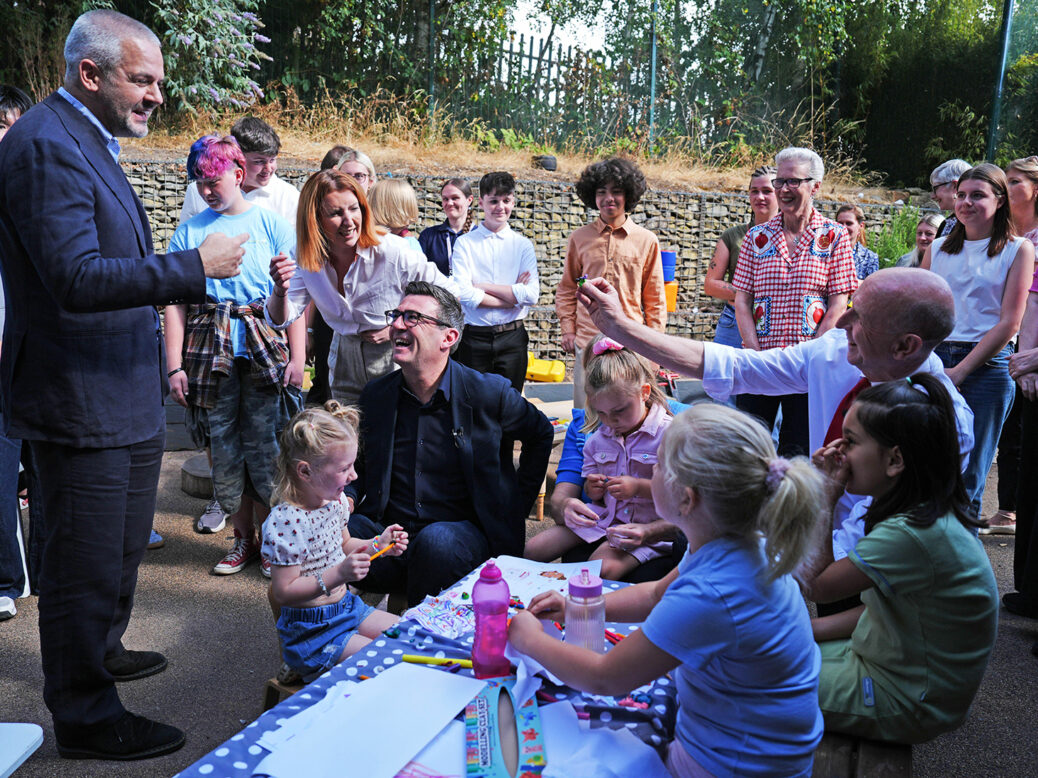
Andy Burnham’s early policy and communications blitz – eating pork scratchings and climbing ladders on TikTok, visiting the Barrow shipyard and Dover coastguard, promising cheaper buses and pubs – seems to have one unifying theory: vibes. Here is a man who appears to be all over your social media feed, all over the news, all over the country. And not only that – he seems happy about it, and if not happy, fired up. He can go from grinning at a gold disc of the Smiths’ The Queen Is Dead to righteous rage at a care system that can only afford our loved ones 15-minute visits.
By flooding the zone, he’s hoping to avoid the early mistakes of Keir Starmer’s premiership, when too little was done to demonstrate the change the country thought it had voted for – and too many gloomy warnings were sounded instead.
But to understand the Burnham project, it is more instructive to look back to 2010, when Labour last lost office. This was a moment of reckoning, when the contours of the debate about what went wrong in the Blair-Brown years were being chiselled into the political landscape.
A common argument was that New Labour had forgotten what Marc Stears, the academic and former aide to Ed Miliband, has described as “both a political value and a political mechanism with the same name: community”. Over 15 years in government, the argument went, Labour had forgotten that to foster national belonging, local connection and solidarity among different groups, you had to have strong communities rather than just the command and control of the state.

Some of the key figures who thrashed this out back then are now in Burnham’s top team, including his chief of staff, James Purnell, and his No 10 policy unit director, Graeme Cooke. New arrivals in No 10 are studying Purnell and Cooke’s 2010 pamphlet, We Mean Power. It quotes the socialist theorist RH Tawney, who in 1944 argued for a society that gave ordinary people more power to live the good life: “There is no such thing as freedom in the abstract… freedom deserves the sublime things which poets have said about it; but, as part of the prose of every day life, it is quite practical and realistic.”
Miliband’s Labour drew on some of this thinking, as the “Blue Labour” intellectuals around him explored a philosophical shift for the party. First, towards a more participatory democratic culture – in response to the critique that New Labour had become too authoritarian, too distant from the cooperatives, trade unions and churches it was drawn from, and too reliant on unaccountable institutions. Second, they considered how to make sense of tradition and social conservatism on the left, given the modern party was characterised as cosmopolitan and detached from the working class.
What, fleetingly, came of all this were the beginnings of a left “communitarian” platform (though no one really likes the word). The successful campaign for a living wage, led by the community organising group Citizens UK, became a lodestar. Classicists and theorists such as Danielle Allen and Bonnie Honig would write memos and meet with shadow cabinet ministers. The US philosopher Michael Sandel spoke at Labour’s 2012 party conference about the moral limits of the market. Miliband called the party’s new vision “One Nation Labour”.
But the gravity of a general election soon dragged the party back down to retail politics and conventional campaigning: “Controls on immigration” merchandise mugs and “35 per cent” strategies. David Axelrod, Barack Obama’s chief campaign strategist who advised Miliband’s Labour, once derided the party’s offer as “Vote Labour and win a microwave”.
As Blue Labour became associated with immigration scepticism, the communitarian tradition that was once at its core has quietly been revived and modernised by new and influential groups in and around the Labour movement. Examples include the We’re Right Here team of eight neighbourhood project leaders (including in Manchester and Bolton), and the UCL Policy Lab’s Ordinary Hope project of community workers, politicos, economists and academics, run by Stears, which I participated in, alongside Purnell and Cooke. Matthew McGregor, who led the 38 Degrees activist network of more than a million people (including nurses, taxi drivers, farmers and shopkeepers), is now Burnham’s director of political strategy.
This world – jokingly described as “woke Blue Labour” by one figure involved – runs not only through some of Burnham’s personnel choices, but also his soul. His fixation on place and cultural Catholicism – and his impulse to devolve power – all reflect the tenets of this tradition, which focuses on community-based public service reform and the way we relate to each other. His idea as mayor for a “Live Well” network – centres and spaces to ensure everyday support for people across Greater Manchester – was inspired by existing local social groups and the Camerados network of “public living rooms” founded by Maff Potts (also an Ordinary Hoper).
“In recent times, we have again lapsed into an instinct to be too centralising, too controlling,” Burnham wrote in last year’s Britain Renewed essay collection. “We need to rediscover communitarianism afresh as a defining but often overlooked strand of the Labour tradition.”
The question, then, isn’t whether there is more to the new Prime Minister than vibes. It is whether the power he gives away is ever felt in “the prose of every day life”.
[Further reading: Andy Burnham is the Green Party’s biggest threat yet]
Content from our partners


Related
This article appears in the 05 Aug 2026 issue of the New Statesman, Europe's shame
Join the debate
Subscribe here to commentMy recollection of the Miliband minor leadership, totally unmentioned in the article, is of Brownite incomprehension with the austerity and wilful sabotage of the Education System and the NHS. While Miliband had his head up his arse doing a policy review Osborne was imposing austerity which resulted in the unnatural deaths of 174,000 people. The comprehensive school system was privatised and the NHS saddled with an administrative layer which had no responsibility and imposed enormous costs. In 2015 Labour not only lost but lost in a way that enabled the Tories to devastate the LibDems and form their own majority government. Tell me how you managed to avoid mentioning any of that. Brexit soon followed, accompanied by the three most incompetent Prime Ministers in our history. Here we are, 16 years later, £100 billion less trade, £40 billion less tax income and just wondering if it is possible to recover the position we were in during the 2010 election.